illumiQ™
One segmented well.
Many detector strategies.
Illuminect is developing illumiQ, a segmented microdose calibrator for preclinical radiopharmaceutical research. Built on an NCI-developed detector platform, it is designed to measure activity in common syringes and vials which support dose, residual-activity, and radionuclide studies.
At a glance
What makes the illumiQ different:
- Multiple independently read detector modules
- Large well for common preclinical syringes and vials
- Coincidence tagging across detector segments
- Digital dead-time and live-time processing
- Direct dose and residual measurement workflow
- Configuration-specific scintillator options
- Customization for unique workflows and applications
How the segmented architecture works
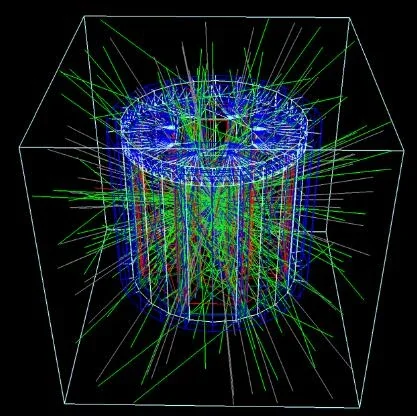
A conventional well counter uses a single detector volume. At increasing activity, pulse pile-up and dead time can distort or suppress the measured count rate. In the illumiQ, detector segments are read independently. A decay that sends photons into more than one segment can be recognized as a correlated event, while the count load is distributed across channels.
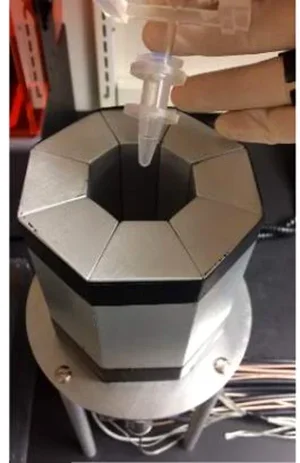
The prototype’s larger sample well was designed to accept containers used in preclinical studies. This allows the same syringe to be measured before administration and again afterward to quantify residual activity—without transferring the sample into a small counting tube.
Premium research configuration
illumiQ Spectra:
preserve radionuclide information.
The spectroscopic pathway uses high-energy-resolution inorganic scintillators and compact photodetectors. Its purpose is not only to report total activity, but also to retain the energy-domain information needed for isotope confirmation and complex decay studies.
Energy spectra
Resolve photopeaks and verify that the selected radionuclide or calibration protocol matches the measured sample.
Mixed samples
Support development of algorithms for paired-isotope studies and separation of overlapping spectral contributions.
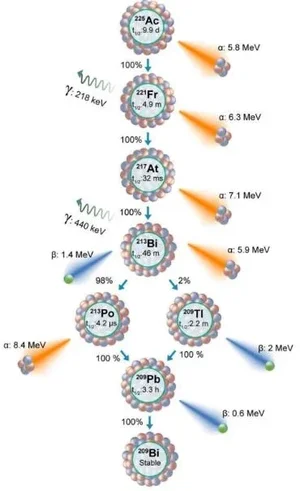
Decay chains
Study parent–daughter behavior where redistributed daughter products can influence efficacy, toxicity, and dosimetry.
Lower-cost high-throughput configuration
illumiQ Range:
prioritize speed, range, and affordability.
The fast-scintillator pathway is intended for laboratories that know which radionuclide is being measured and need a fast, broad-range activity instrument rather than energy spectroscopy.
Faster scintillation
Short decay times can reduce pile-up pressure and support higher count-rate operation.
Lower-cost material
Fast scintillators offer a more economical detector pathway and potential in-house fabrication options.
Extended high-rate range
Preliminary bench observations indicate a potential range extension of at least approximately threefold; formal validation is in progress.
Important trade-offFast scintillators generally do not provide a distinct photopeak for reliable isotope identification. illumiQ Range should be positioned as a calibrated activity instrument for known radionuclides—not as a spectroscopic isotope analyzer.
Configuration guide
Select the version by the scientific question.
| Capability | illumiQ Spectra | illumiQ Range |
|---|---|---|
| Primary value | Energy-resolved activity measurement | Affordable, fast, broad-range activity measurement |
| Scintillator pathway | High-resolution scintillator | Fast scintillator |
| Photopeak / isotope confirmation | Yes, design goal | No |
| Dual-isotope or daughter analysis | Target application | Not intended |
| High-rate response | High compared to any COTS devices | Higher due to fast response |
| Relative instrument cost | Premium | Economy |
| Best-fit users | TAT, radionuclide development, metrology, paired-isotope research | Routine preclinical dose preparation, biodistribution, tracer QC, training labs |